
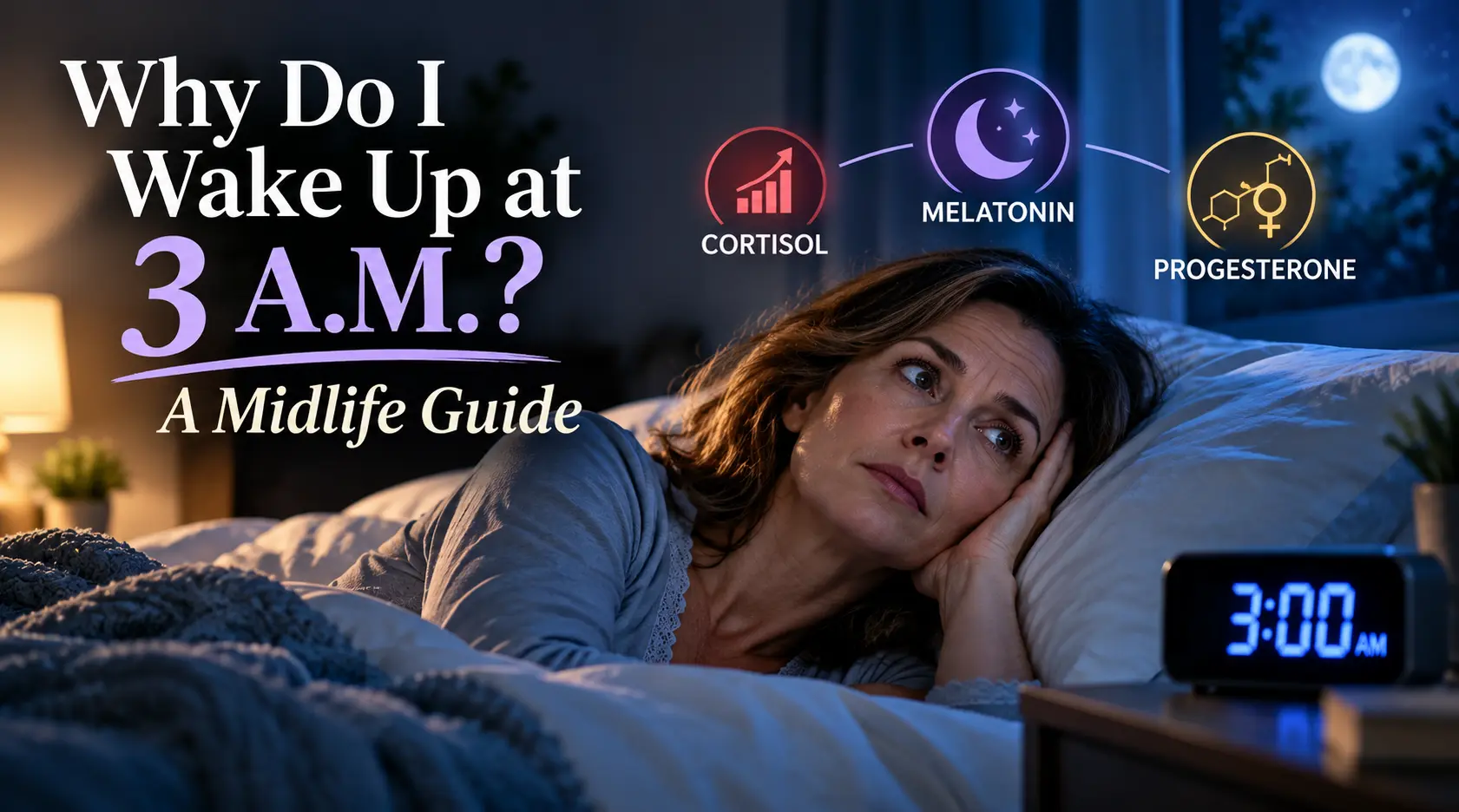
Why Do I Wake Up at 3 A.M.? A Midlife Guide
Why do I wake up at 3 a.m. every single night? If you’re in your forties or fifties, your changing hormones are a likely part of the answer, and you’re in very good company. The pattern is common; it usually has explainable causes, and most of them respond to the right changes. Here’s what’s probably happening in your body, and what to do about it.
Why do I wake up at 3 a.m. during perimenopause?
Waking at 3 a.m. in perimenopause usually comes from several things stacking up: shifting estrogen and progesterone, night sweats you may not fully register, and a stress system that switches on faster than it used to. No single cause explains every woman, which is why the pattern feels so baffling.
Start with something true for everybody. Sleep gets lighter in the second half of the night. The drive to sleep that built up all day is mostly spent by 3 a.m., so small disturbances are easier to notice. In midlife, the threshold for waking drops even lower.
The numbers match what you’re feeling. The Study of Women’s Health Across the Nation (SWAN) has followed more than 3,000 midlife women across the United States. An analysis presented at the 2016 North American Menopause Society meeting found that 31% to 42% of perimenopausal women reported symptoms meeting criteria for insomnia. Waking after falling asleep rose from 26% to 36% as women moved deeper into the transition. So no, you’re not imagining it. And you’re not doing sleep wrong.
How do hormones cause 3 a.m. waking?
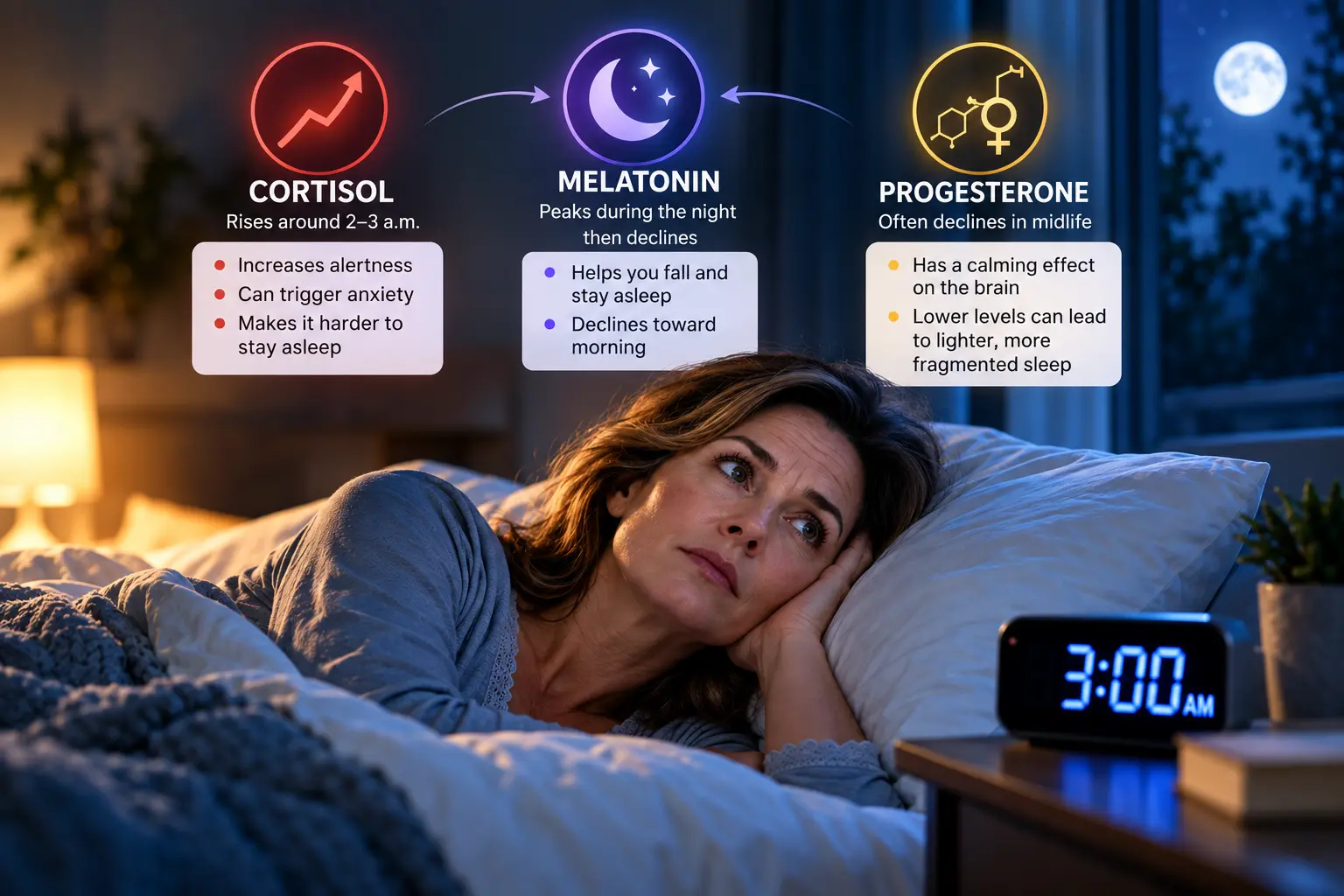
Perimenopause makes estrogen and progesterone swing unpredictably, and those swings affect both your body’s temperature control and how calm your brain feels at night. The result is lighter sleep and easier waking.
Progesterone has a calming, sleep-friendly effect, and it often declines first because ovulation becomes irregular. Estrogen helps regulate body temperature. When it wobbles, your internal thermostat gets twitchy, and a small rise in core temperature can set off a hot flash or night sweat.
Here’s the part many women miss. A night sweat doesn’t always feel like one. You might just surface at 3 a.m. warm, wide awake, and with your heart thumping, and never connect it to a hot flash. Early sleep-lab studies found that women with hot flashes had lower sleep efficiency than women without them. If you find yourself kicking off the covers at 3 a.m., treat that as a clue.
One honest caveat: hormone lab values don’t neatly predict who sleeps badly. In at least one large midlife cohort, poor sleep wasn’t tied to estradiol levels. That’s a big reason a single blood test rarely settles the question, and why a good clinician listens to your pattern, not just your labs.
Is 3 a.m. waking a cortisol or adrenal problem?
Stress hormones can contribute to 3 a.m. waking, but “adrenal fatigue” isn’t a real diagnosis, and the popular idea that 3 a.m. is your “liver hour” has no scientific backing. The better-supported explanation is plainer: a stress system that runs hot makes light sleep easier to break.
The Endocrine Society says no scientific proof exists that adrenal fatigue is a true medical condition. Cortisol does follow a daily rhythm, though, climbing through the early morning hours toward waking. In the early sleep-lab work on midlife women, those with the poorest sleep also had higher morning urinary cortisol. Combine a stress response that’s already primed with lighter perimenopausal sleep, and a small nudge at 3 a.m. can be enough to bring you fully awake.
Then the mind piles on. It’s quiet, nothing is distracting you, and the to-do list starts sounding like an emergency. That’s ordinary biology, not a character flaw. And if anyone tells you your adrenals are “fatigued” and hands you a supplement stack, ask which test showed it and what result would change the plan.
What else can cause 3 a.m. waking besides hormones?
Alcohol, sleep apnea, anxiety, and blood sugar dips can each wake you around 3 a.m., and they often overlap with perimenopause changes instead of replacing them. Sorting out which ones apply to you saves months of guessing.
| Possible cause | What it can look like | What to do about it |
| Night sweats and hot flashes | Waking warm or damp, heart pounding, kicking off the covers | Cool the room, use breathable bedding, and ask about treatment (see below). |
| Alcohol | Falling asleep easily, then waking in the second half of the night | Stop drinking a few hours before bed, or skip it for two weeks and compare your nights. |
| Sleep apnea | Snoring, gasping, dry mouth or headache in the morning, tiredness despite enough hours | Ask for a sleep study. Don’t wait it out. |
| Anxiety or racing thoughts | Waking into a worry loop that won’t quit | Try the CBT-I steps below, write a worry list before bed, and get support if anxiety is daily. |
| Blood sugar dips | Waking hungry, shaky, or sweaty | Evidence is thin in people without diabetes. If it happens often, mention it to a clinician. |
Late caffeine (its effects can linger for many hours), needing the bathroom, certain medications, and thyroid problems can also break up sleep. A thorough clinician screens for these instead of assuming it’s all hormones.
What should I do when I wake up at 3 a.m.?
Don’t check the clock, keep the lights low, and if you’re still awake after about 20 minutes, get up and do something quiet until you feel sleepy again. That’s stimulus control, a core piece of CBT-I, and it works because it stops your brain from linking your bed with frustration.
- Turn the clock face away. The math (“only four hours left”) wakes you up more than the awakening itself.
- Keep light dim and warm-toned, and leave your phone alone.
- If you feel hot, cool off first: lighter layer, cooler room, a sip of cool water. That covers a possible night sweat.
- Try slow breathing with a longer exhale to settle a racing mind. Use it for calm, though, not as a hot flash treatment. The Menopause Society found paced breathing doesn’t reduce hot flashes.
- Keep a notebook by the bed. Write the worry down and let it wait until morning.
- Get up at the same time every day, even after a rough night. Sleeping in to “catch up” tends to make the next 3 a.m. more likely.
Give these changes three to four weeks before judging them, and jot down what each night looked like: bedtime, alcohol, whether you woke hot, and when you woke. Patterns show up on paper that memory misses, and a clinician can put that log to work. If your awakenings cluster on nights after wine or on nights you were sweating, you’ve just learned something no lab test could tell you.
What actually helps over the long run?
For persistent 3 a.m. waking, the best-supported first step is cognitive behavioral therapy for insomnia (CBT-I). If night sweats are driving your awakenings, treating the hot flashes directly may improve your sleep too.
The American College of Physicians recommends CBT-I as the first treatment for chronic insomnia in adults, ahead of sleep medications, which carry more risk of side effects. It’s structured and time-limited, and you can do it with a therapist, through a phone or web program, or with a good self-help book.
If hot flashes are the trigger, you have real options. The Menopause Society’s 2023 position statement says hormone therapy remains the most effective treatment for hot flashes and should be considered for women within 10 years of their final period. For women who can’t or would rather not take hormones, it recommends nonhormone options backed by good evidence, including CBT, clinical hypnosis, certain antidepressants (SSRIs and SNRIs), gabapentin, and fezolinetant. Which of these fits you depends on your health history, so it’s a conversation for a clinician, not a guess.
One more thing worth saying plainly. That same statement did not recommend supplements or herbal remedies for hot flashes, because trials haven’t shown that they work. That doesn’t mean a supplement can never help you sleep. It does mean the marketing has run ahead of the evidence. Check with a clinician before adding anything, especially if you take other medications.
Looking for another option to support your nighttime routine? Read our Yu Sleep review to learn about the product, its ingredients, and what to consider before buying.
When should I talk to a clinician about 3 a.m. waking?
Make an appointment if you’re waking at least three nights a week for three months (the threshold for chronic insomnia), if you snore loudly or gasp in your sleep, if daytime exhaustion is affecting your work or safety, or if your mood is sliding. Bring up very heavy or unusually irregular bleeding too, since that deserves its own evaluation. Chest pain, or a racing heart that doesn’t settle, needs urgent care.
Frequently asked questions about waking up at 3 a.m.
Is waking up at 3 a.m. a sign of perimenopause?
It can be, but it isn’t proof by itself. Night waking becomes more common through the menopause transition, and it often comes with changing periods, hot flashes, or night sweats. Sleep apnea, alcohol, anxiety, and other conditions also cause it, so a clinician should look at the whole picture.
Why do I wake up at 3 a.m. with anxiety or a racing heart?
A hot flash, a surge in your stress response, or sleep apnea can each wake you with a pounding heart, and once you’re awake, worry fills the quiet. If it happens often, or comes with chest pain or shortness of breath, get it checked instead of assuming it’s anxiety.
Is waking at 3 a.m. a liver or adrenal problem?
No scientific evidence links 3 a.m. waking to the liver, and the Endocrine Society says adrenal fatigue isn’t a proven medical condition. Real conditions such as thyroid disease or sleep apnea can cause night waking, so ask for an evidence-based workup.
Will waking up at 3 a.m. stop after menopause?
Not automatically. In SWAN analyses, night awakenings were generally stable from before to after the final period, and trouble falling asleep, early waking, and frequent hot flashes predicted awakenings that continued. Treating the causes works better than waiting it out.
Should I take melatonin or magnesium for 3 a.m. waking?
No supplement has a track record strong enough to promise results for midlife night waking. The Menopause Society doesn’t recommend supplements or herbal remedies for hot flashes, and the evidence for sleep varies by product. Talk with a clinician before starting anything, especially if you take medications.
Your next step
Waking at 3 a.m. feels lonely, yet it’s one of the most common midlife sleep complaints, and it has levers you can pull. Start with three cheap experiments this week: cool the room, cut evening alcohol, and stop clock-watching. If nothing shifts within a few weeks, bring your notes to a clinician. To learn more or get in touch, visit vitaore.com.
This article is educational and isn’t a substitute for personal medical advice.

Related Posts

How to Improve Sleep Quality Naturally: 7 Simple Habits for Better Sleep

What Is Sleep Hygiene? 10 Habits for Better Sleep