
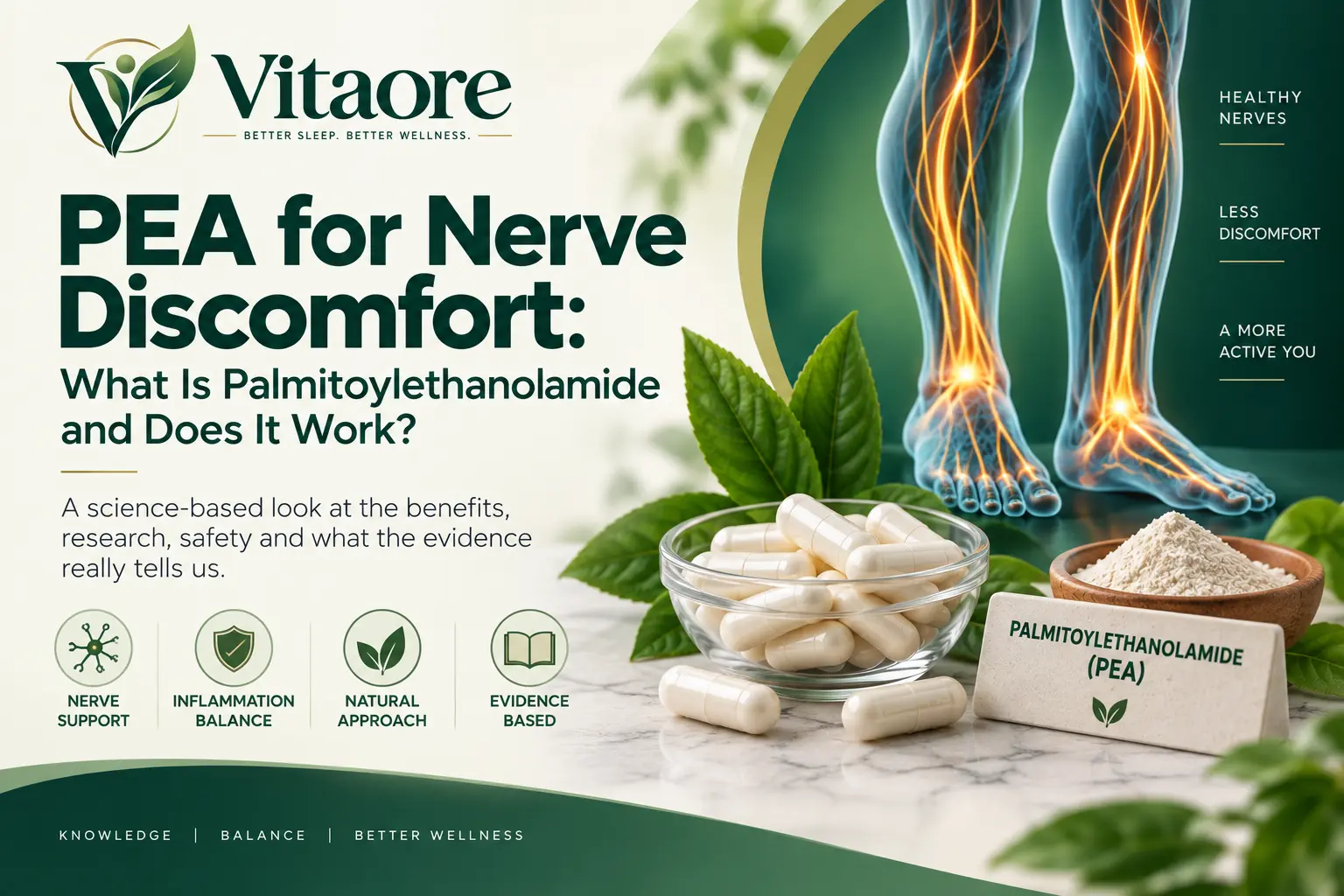
PEA for Nerve Discomfort: What Does the Human Evidence Really Say?
When nerve discomfort starts interfering with sleep, movement, or everyday activities, it is natural to look beyond conventional pain relief. That is where palmitoylethanolamide, better known as PEA, has attracted attention. Unlike many familiar pain supplements, PEA is a compound the human body naturally produces, and researchers have been studying its potential role in pain and inflammation for years.
But there is an important question behind the growing interest: does PEA actually help people with nerve discomfort, or does its promising biology sound better than the clinical evidence?
The answer is more nuanced than either a simple yes or no.
Clinical trials and systematic reviews have reported reductions in pain with PEA, including research involving neuropathic pain. A 2022 meta-analysis covering 933 patients found favorable pain outcomes, while a 2026 systematic review specifically examining diabetic neuropathic pain also reported promising results. However, both bodies of evidence have limitations, including differences between formulations, small study populations, and substantial variation between studies.
Understanding those limitations is just as important as understanding the positive findings. Here is what the research actually tells us about PEA, nerve discomfort, dosage, safety, and what remains uncertain.
What Is Palmitoylethanolamide (PEA)?
Palmitoylethanolamide, commonly abbreviated as PEA, is a naturally occurring fatty acid amide produced by the human body. It is also found in certain foods, including egg yolks, soybeans, and peanuts. PEA is available in the United States as an over-the-counter dietary supplement.
PEA is sometimes described as an endocannabinoid-like or cannabinoid-like compound because of its relationship with biological pathways involved in pain and inflammation. However, PEA is not CBD, THC, or cannabis.
CBD and THC are cannabinoids found in cannabis and hemp. PEA is a different naturally occurring fatty acid amide and does not produce the intoxicating effects associated with THC. WebMD notes that although PEA can interact with some receptors that are also relevant to CBD-related pathways, the compounds are not the same.
Researchers became interested in PEA because of its potential influence on inflammatory processes and pain signaling. That biological rationale has led to clinical studies examining PEA in several types of pain, including neuropathic pain.
However, the existence of a biological mechanism does not automatically mean that a supplement produces meaningful results in humans. That is why clinical trials are essential.
Why Is PEA Being Studied for Nerve Discomfort?
Nerve-related discomfort can involve much more than a simple pain signal.
People with neuropathic symptoms may experience:
- Burning sensations
- Tingling or pins and needles
- Shooting or electric-like pain
- Numbness
- Increased sensitivity to touch
- Pain caused by stimuli that normally would not hurt
Inflammatory signaling and changes in nervous-system sensitivity can contribute to some forms of neuropathic pain. Researchers have therefore investigated compounds that may influence these processes.
PEA is particularly interesting because it appears to interact with pathways involved in inflammation, immune activity, and pain signaling. A systematic review of randomized controlled trials described PEA as a bioactive lipid mediator with anti-inflammatory and analgesic properties and found that the strongest clinical evidence was concentrated in pain management and general wellbeing outcomes, particularly with micronized, ultramicronized, or cold-water-dispersible formulations.
That does not mean PEA is a proven treatment for every type of nerve discomfort. It means there is enough biological and clinical evidence to justify continued research.
How Does PEA Work?
The proposed mechanisms behind PEA are more complicated than simply saying that it is an “anti-inflammatory.”
One important pathway involves PPAR-alpha, a receptor involved in regulating inflammatory and metabolic processes. PEA may also influence mast cells and other cells involved in inflammatory signaling.
Researchers have also investigated PEA’s effects on neuroinflammation, which refers broadly to inflammatory activity involving the nervous system.
In simple terms, the theory is that PEA may help regulate some of the processes that can amplify pain signaling.
But there is an important distinction:
A proposed mechanism explains why researchers are interested in PEA. It does not prove that taking PEA will relieve pain in every person.
This distinction matters because supplement marketing often moves directly from laboratory mechanisms to claims about real-world results. Human clinical research is needed to establish whether those biological effects translate into meaningful improvements.
What Does the Human Research on PEA Actually Show?
The human evidence is more substantial than the evidence behind many supplements marketed for nerve health, but it is not flawless.
A 2022 systematic review and meta-analysis examined clinical evidence involving 933 patients with nociceptive, musculoskeletal, and neuropathic pain. The researchers reported that PEA performed better than control groups for pain reduction. However, the analysis also found extremely high statistical heterogeneity, with an I² value of 99%, and the funnel plot suggested possible publication bias. The authors concluded that larger, adequately powered randomized double-blind trials were still needed.
That is an important qualification.
A positive meta-analysis does not mean that every study included in it was equally strong. When studies differ substantially in populations, conditions, formulations, doses, or methods, combining them can produce an overall result that needs careful interpretation.
What does more recent research show?
A 2023 systematic review and meta-analysis focused specifically on double-blind randomized controlled trials. It included 11 studies involving a combined 774 patients and found lower pain scores with PEA compared with placebo or active comparators. The researchers also reported some improvements in quality of life and functional status and found no major side effects attributed to PEA in the included studies.
A broader 2024 systematic review examined 47 randomized controlled trials across different patient populations. It concluded that the strongest evidence was in pain management and general wellbeing, particularly with micronized, ultramicronized, or cold-water-dispersible formulations. At the same time, the review covered many different health conditions, so its findings should not be interpreted as proof that PEA works equally well for every form of pain or neuropathy.
A 2025 meta-analysis included 18 randomized studies involving 1,196 patients across different pain conditions. It reported significant reductions in pain at several follow-up points, including six, eight, and 24 to 26 weeks, with favorable findings across nociceptive, neuropathic, and nociplastic pain categories. Again, these populations were diverse, so the results should not be treated as direct evidence for every specific neuropathy diagnosis.
Overall, the research is encouraging, but it is more accurate to say that PEA has demonstrated potential for pain reduction in several clinical settings than to say it has been conclusively established as a treatment for neuropathy.
PEA and Neuropathic Pain
Neuropathic pain is pain caused by injury or dysfunction involving the nervous system. It can occur for many different reasons.
Diabetes is one cause, but neuropathic symptoms can also occur with certain medications, chemotherapy, nerve compression, infections, injuries, nutritional deficiencies, and other conditions.
This matters because evidence from one type of neuropathy cannot automatically be transferred to another.
The existing PEA research includes various neuropathic conditions, but the strength of evidence varies considerably. Some studies involve diabetic peripheral neuropathy, while others examine conditions such as sciatic or other chronic neuropathic pain.
Therefore, a reader should not interpret “PEA has been studied for neuropathic pain” as meaning that PEA has been proven effective for every possible cause of nerve discomfort.
What Does the Research Say About PEA for Diabetic Neuropathy?
Diabetic peripheral neuropathy is one of the most relevant areas for PEA research.
A particularly useful randomized controlled trial published in 2022 included 70 people with diabetic-related peripheral neuropathic pain. Participants received either 600 mg of PEA or placebo daily for eight weeks. The trial was quadruple-blinded and placebo-controlled, with a 94% study completion rate.
The researchers reported significant reductions in total diabetic neuropathic pain and several neuropathic pain measures in the PEA group compared with placebo. Improvements were also reported in sleep-related measures and some mood and inflammation measures. No significant safety problems were identified in the trial, and the treatment was described as well tolerated.
That is a meaningful finding, but it was still one relatively small clinical trial.
What does the 2026 systematic review add?
A 2026 systematic review and meta-analysis specifically examined PEA for diabetic neuropathic pain. Only three studies involving 188 participants met its inclusion criteria.
The review found that PEA, either alone or in combination, was consistently associated with reductions in neuropathic pain compared with control. The meta-analysis also reported improvements in several secondary outcomes.
But the researchers highlighted major limitations. The studies were heterogeneous, sample sizes were small, and combination formulations were frequently used. That makes it difficult to determine how much of the observed effect can be attributed specifically to PEA. The researchers concluded that PEA is promising as a potential adjunctive option but that larger, higher-quality trials are needed.
This is probably the fairest summary of the current evidence:
PEA looks promising for diabetic neuropathic pain, but the evidence base is still too limited and heterogeneous to call it a firmly established treatment.
How Long Does PEA Take to Work?
PEA should not automatically be viewed as an immediate pain reliever.
Clinical studies have used different treatment durations, making it difficult to establish a universal timeline for individual users.
A 2024 systematic review and meta-analysis specifically examined extended treatment with micronized PEA. It included nine studies involving 742 patients and found greater pain reduction after at least 60 days compared with shorter treatment periods. The authors reported that pain reduction continued over the second month in the studies they analyzed.
WebMD also notes that research suggests PEA may take one to two months to show benefits for some forms of chronic pain, although the response can vary depending on the condition and product.
This should not be interpreted as a promise that everyone will notice an effect within a particular number of weeks.
The research simply suggests that PEA’s potential effects may develop over time rather than behaving like an immediate painkiller.
What Dose of PEA Has Been Studied?
There is no single universally established dose for every person or every condition.
One important diabetic neuropathy trial used 600 mg of PEA per day for eight weeks.
Other clinical research has used different amounts and formulations.
This is why readers should be careful when comparing supplement labels with research papers. A clinical trial dose does not automatically become a personal dosing recommendation.
Three things can differ:
- The dose used in a clinical study
- The amount provided by a particular supplement
- The dose that may be appropriate for an individual
Formulation also matters. A 600 mg serving of one form of PEA should not automatically be assumed to be equivalent to 600 mg of every other formulation.
If you are considering PEA supplementation, especially while taking medication or managing a chronic condition, discuss the appropriate product and dose with a healthcare professional.
Does Micronized or Ultramicronized PEA Work Better?
You may notice terms such as micronized PEA and ultramicronized PEA on supplement labels.
These terms generally refer to processing that reduces particle size.
The reason manufacturers do this is that smaller particles may improve how a compound disperses and is absorbed. WebMD notes that micronized PEA may be absorbed better than PEA found in foods, while also noting that it is not clear whether ultramicronized PEA is absorbed better than micronized PEA.
There is clinical research specifically involving micronized and ultramicronized formulations. The 2024 systematic review of randomized controlled trials found that some of the strongest pain-related evidence involved these formulations.
The 2024 extended-treatment meta-analysis also specifically evaluated micronized PEA and found greater pain reduction with treatment lasting at least 60 days compared with shorter treatment.
Still, better absorption does not automatically mean better clinical outcomes for every product.
Consumers should look at the complete label and consider whether the specific formulation has actually been studied.
PEA Side Effects and Safety
PEA appears to have been generally well tolerated in clinical research, but that does not mean it is completely risk-free.
WebMD identifies upset stomach as the most common reported side effect and notes that side effects may vary according to dose and the specific product. It also warns that allergic reactions can occur.
The 2026 systematic review of diabetic neuropathic pain described the available safety data as limited but generally favorable, with mild and self-limited adverse events reported in the included studies.
Pregnancy and breastfeeding deserve particular caution. WebMD states that it is not known whether PEA can affect pregnancy or a fetus, or whether it passes into breast milk. People in these situations should speak with a healthcare professional before using it.
People with known allergies to PEA or ingredients in a specific product should also avoid that product.
Does PEA Interact With Medications?
The available interaction information is limited.
WebMD currently states that there are no known interactions between PEA and medicines, but it also emphasizes that interaction research is incomplete. That distinction is important. “No known interactions” does not mean that PEA has been proven safe with every medication or medication combination.
If you take prescription drugs, over-the-counter medications, vitamins, herbs, or other supplements, tell your healthcare professional about everything you use.
This is particularly important when adding a supplement to an existing treatment plan for chronic pain or neuropathy.
Can PEA Repair or Regenerate Damaged Nerves?
There is not enough human evidence to say that PEA repairs or regenerates damaged nerves.
This distinction is essential.
A study can show that participants experience less pain without proving that damaged nerve fibers have been restored.
The existing clinical research primarily examines outcomes such as:
- Pain intensity
- Neuropathic pain scores
- Quality of life
- Function
- Sleep
- Other clinical or biological measures
The 2026 diabetic neuropathy review reported improvements in pain and some secondary outcomes, but the authors still called for larger and higher-quality trials before PEA’s role in clinical practice can be fully defined.
Therefore, claims that PEA “regenerates nerves,” “repairs damaged nerves,” or reverses neuropathy go beyond what the current human evidence establishes.
Is PEA Useful for Every Type of Neuropathy?
Not necessarily.
The underlying cause of neuropathy matters.
Diabetic neuropathy
This is one of the areas where PEA has direct clinical research, including the 70-person randomized trial discussed above.
Chemotherapy-related neuropathy
This type of neuropathy has a different underlying cause. Evidence involving diabetic neuropathy cannot automatically be applied to people experiencing nerve symptoms after chemotherapy.
Nerve compression
Conditions such as carpal tunnel syndrome involve mechanical pressure or irritation of a nerve. A supplement cannot be assumed to address the underlying compression simply because PEA has been studied for pain.
Nutritional deficiency
If nerve symptoms result from a vitamin deficiency, identifying and correcting the deficiency is an important part of addressing the underlying problem.
Alcohol-related or unexplained neuropathy
These situations also require attention to the cause rather than simply treating symptoms with a supplement.
The broader lesson is simple: PEA research should not be generalized beyond the populations and conditions actually studied.
PEA vs Other Supplements for Nerve Health
PEA is only one compound being investigated for nerve-related symptoms.
Other ingredients that appear in the broader nerve-health literature include:
- Alpha lipoic acid
- Vitamin B12
- Acetyl-L-carnitine
- Curcumin
- Certain B vitamins
That does not mean one is automatically better than another.
Each ingredient has its own evidence base, study populations, doses, formulations, safety considerations, and limitations.
For example, research into alpha lipoic acid has primarily focused on diabetic peripheral neuropathy, while PEA research spans several chronic pain and neuropathic pain populations.
Comparing ingredients based simply on the number of positive studies can therefore be misleading.
A better question is: What condition was studied, what outcome improved, what formulation was used, and how reliable was the study?
How to Evaluate a PEA Supplement
If you are considering a PEA supplement, look beyond the front of the bottle.
Check the exact PEA amount
The label should clearly state how much PEA is provided per serving.
A proprietary blend that does not disclose the individual amount makes comparison more difficult.
Check the formulation
Look for clear information about whether the product contains standard, micronized, or ultramicronized PEA.
Remember that a formulation used in clinical research is not necessarily equivalent to every PEA product sold online.
Examine the rest of the formula
If PEA is combined with several other ingredients, determine whether the finished combination has actually been studied.
Evidence for PEA alone does not prove that a multi-ingredient formula works.
Look for transparency
Useful information includes:
- Full ingredient amounts
- Serving size
- Manufacturer information
- Clear labeling
- Manufacturing details
- Third-party testing where applicable
WebMD notes that the FDA has not tested PEA products to confirm that they contain the ingredients stated on their labels, while some supplements undergo third-party testing.
Be skeptical of dramatic claims
Statements such as “regenerates nerves,” “reverses neuropathy,” or “guaranteed pain relief” should not be treated as established scientific conclusions.
The strongest supplement evaluation starts with the actual evidence, not the marketing language.
What About PEA in Nu Nerve?
Nu Nerve includes PEA as one of the ingredients highlighted in its broader nerve-support formula.
That makes the PEA research relevant when evaluating why the ingredient appears in the formula. However, evidence involving PEA as an individual compound should not be interpreted as clinical proof that Nu Nerve itself produces the same results.
The formulation, amounts, combination of ingredients, and finished-product evidence all matter separately.
For a separate examination of the complete formula, ingredients, available evidence, customer feedback, pricing, and limitations, see our detailed Nu Nerve review.
Frequently Asked Questions About PEA
What is PEA used for?
PEA is a naturally occurring fatty acid amide that is available as a dietary supplement and is commonly studied for chronic pain. Research has examined its potential role in several types of pain, including neuropathic pain. However, evidence varies by condition, formulation, and study quality, so PEA should not be considered a proven treatment for every pain condition.
Does PEA help nerve pain?
Some clinical trials and meta-analyses have reported reductions in neuropathic pain with PEA. A 2022 randomized trial involving people with diabetic peripheral neuropathic pain found significant improvements in several pain measures after eight weeks. However, the overall evidence remains limited by differences between studies and formulations.
Does PEA work for diabetic neuropathy?
PEA appears promising for diabetic neuropathic pain, but the evidence is not yet definitive. A 2026 systematic review found reductions in pain across three studies involving 188 participants, while emphasizing substantial heterogeneity and small sample sizes. Larger, well-designed trials are needed to establish its clinical role more firmly.
How long does PEA take to work?
There is no guaranteed timeframe. Some studies have assessed outcomes after several weeks, while research on micronized PEA suggests that benefits may continue to develop with longer treatment. WebMD notes that some research suggests one to two months may be needed to see benefits for certain forms of chronic pain. Individual responses can vary.
What dose of PEA has been studied?
Clinical studies have used different doses and formulations. One randomized trial involving diabetic peripheral neuropathic pain used 600 mg of PEA daily for eight weeks. That does not mean 600 mg is the appropriate dose for every individual. Study dose, formulation, product serving size, and personal medical recommendations should be considered separately.
Is PEA safe?
PEA has generally been well tolerated in clinical research. Upset stomach is among the most commonly reported side effects, and allergic reactions are possible. Safety information is less complete for pregnancy and breastfeeding, so professional advice is recommended in those situations. People taking medications should also discuss PEA with a healthcare professional.
Does PEA repair damaged nerves?
Current human evidence does not establish that PEA repairs or regenerates damaged nerves. Some studies suggest it may reduce pain or other symptoms, but symptom improvement is not equivalent to restoring damaged nerve fibers. Claims about nerve regeneration should therefore be treated cautiously unless supported by direct clinical evidence.
Is PEA the same as CBD?
No. PEA and CBD are different compounds. PEA is a naturally occurring fatty acid amide, while CBD is a cannabinoid found in cannabis and hemp. PEA does not produce the intoxicating effects associated with THC. Although the compounds can interact with some overlapping biological pathways, they should not be treated as interchangeable.
Is micronized PEA better?
Micronized and ultramicronized PEA have smaller particle sizes and may have different absorption characteristics than standard PEA. Some clinical research has specifically used micronized or ultramicronized formulations. However, improved absorption does not automatically establish superior clinical outcomes for every product, and WebMD notes that it remains unclear whether ultramicronized PEA is absorbed better than micronized PEA.
The Bottom Line on PEA for Nerve Discomfort
PEA is not just another supplement with a promising laboratory story. There is a real body of human research examining its potential role in pain, including neuropathic pain.
Several systematic reviews and randomized trials have reported favorable results. A 2022 analysis involving 933 patients found evidence of pain reduction, while a 2023 analysis of double-blind randomized trials also found lower pain scores with PEA. More recently, a 2025 meta-analysis involving 1,196 patients reported significant improvements across several pain categories.
The evidence specifically for diabetic neuropathy is also encouraging. The 2022 randomized trial found significant improvements in several neuropathic pain measures after eight weeks of 600 mg daily PEA. The 2026 systematic review similarly found promising results, but it included only three studies with 188 participants and highlighted substantial heterogeneity and the frequent use of combination formulations.
So the most responsible conclusion is not that PEA is proven to cure neuropathy.
A better interpretation is that PEA is a promising compound for pain and nerve-related discomfort, with human evidence suggesting potential benefits in some conditions, but important uncertainties remain about which patients benefit, which formulations are most effective, and how well the findings apply across different types of neuropathy.
Most importantly, evidence for PEA itself does not automatically prove that a particular supplement containing PEA will work. The exact formulation, dose, additional ingredients, product quality, and finished-product research all deserve consideration.
And if nerve symptoms are persistent, unexplained, severe, rapidly worsening, or accompanied by weakness or loss of coordination, finding the underlying cause should take priority over choosing a supplement.
Medical Disclaimer
This article is provided for general educational purposes and does not constitute medical advice, diagnosis, or treatment. Dietary supplements should not replace evaluation or treatment of an underlying medical condition.
Persistent or unexplained numbness, burning, tingling, pain, weakness, or changes in sensation should be discussed with a qualified healthcare professional. Sudden weakness, severe numbness, loss of coordination, or rapidly worsening neurological symptoms may require prompt medical evaluation.
People taking prescription or over-the-counter medications, as well as those who are pregnant or breastfeeding, should consult a healthcare professional before using PEA.
References & Resources
Primary Scientific Sources
- 2026 systematic review and meta-analysis of PEA for diabetic neuropathic pain
View the study on PubMed - 2022 randomized controlled trial of PEA for diabetic peripheral neuropathic pain
View the study on PubMed - 2023 systematic review and meta-analysis of double-blind randomized trials
View the study on PubMed - 2024 systematic review of randomized controlled trials
View the study on PubMed - 2025 meta-analysis of PEA in pain management
View the study on PubMed



One thought on “PEA for Nerve Discomfort: What Does the Human Evidence Really Say?”
Comments are closed.