VisiFlora Reviews: Ingredients, Benefits, Side Effects, Price and Does It Work?
If you are searching for VisiFlora Reviews, you are probably trying to determine whether this vision-support supplement is worth considering or whether its marketing claims go beyond the available evidence. VisiFlora is marketed as a daily dietary supplement containing vitamins, minerals, carotenoids, botanical extracts, and antioxidant compounds. Promotional material also emphasizes a proposed connection between gut health and eye health.
This review looks at the formula, potential benefits, evidence, safety considerations, pricing, refund policy, customer feedback, FDA status, and the question many buyers ultimately want answered: does VisiFlora actually work? The important distinction throughout is between evidence for individual ingredients and evidence specifically testing the finished VisiFlora formula.
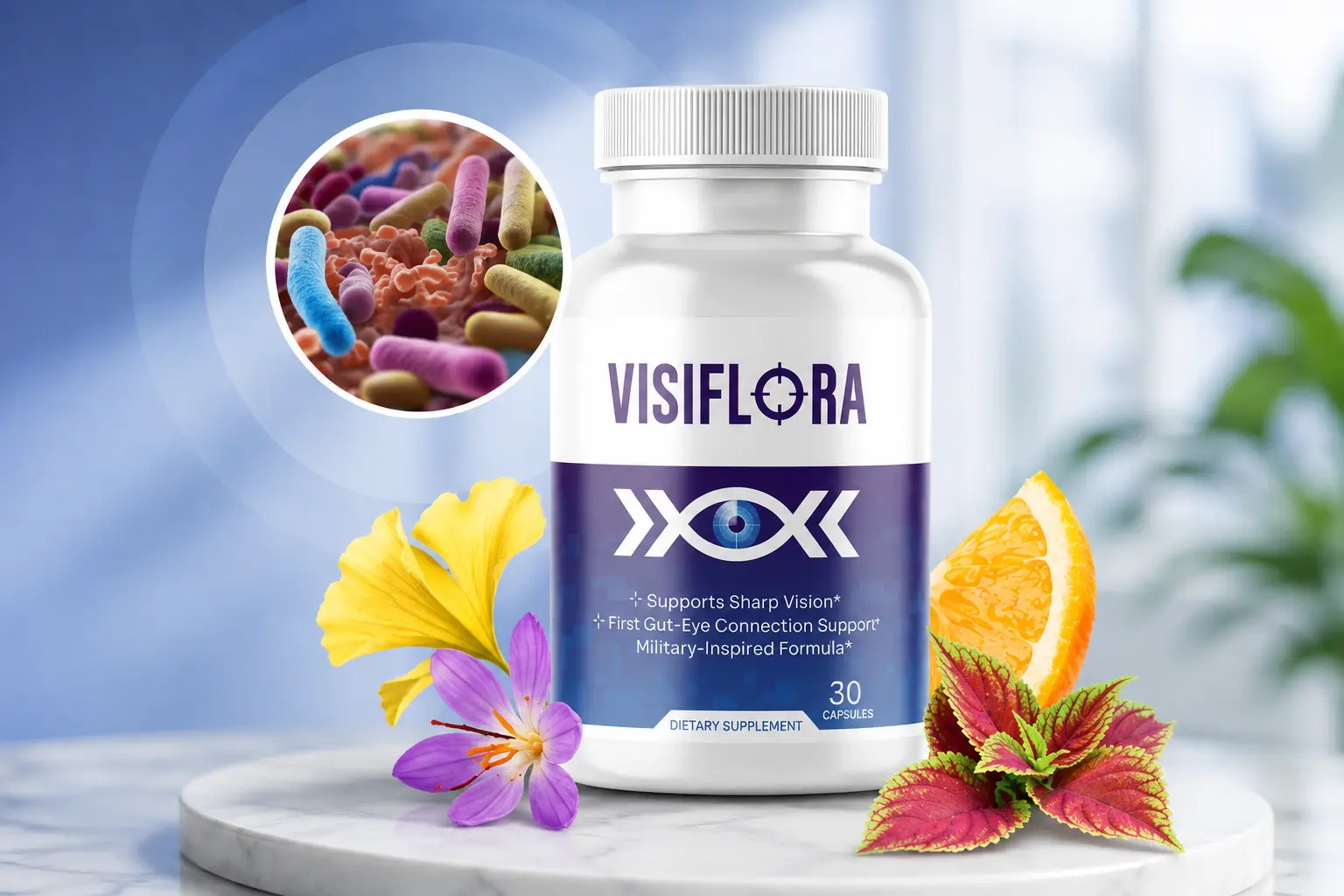
What Is VisiFlora?
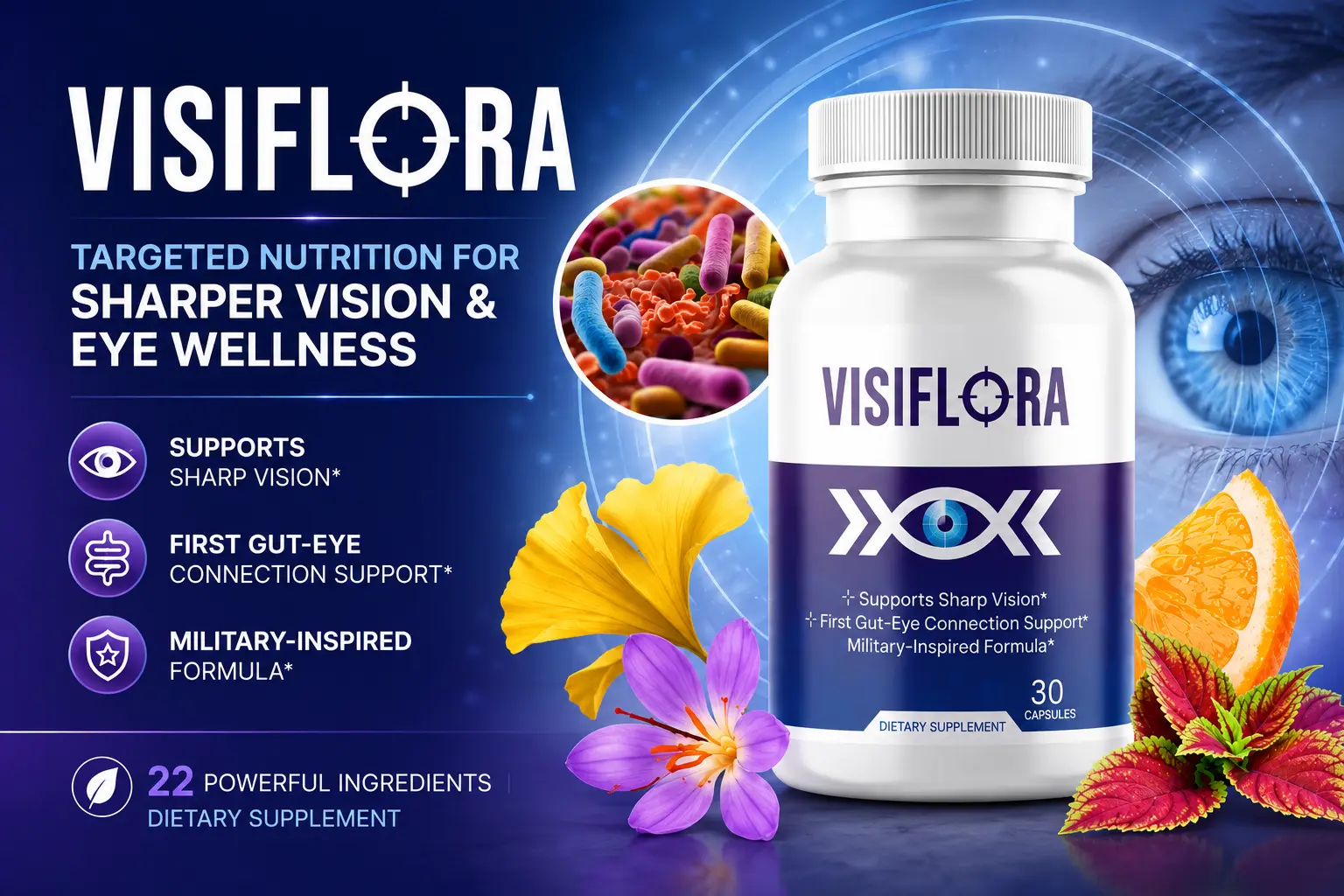
VisiFlora is marketed as a daily dietary supplement intended to support general eye and vision wellness. Current online product information describes it as a capsule taken once daily with food and markets the formula as containing 22 ingredients.
The product is positioned around several areas of eye nutrition, including antioxidant support, carotenoids such as lutein and zeaxanthin, and nutrients associated with normal visual function. Its marketing also places considerable emphasis on the gut-eye connection, suggesting that supporting the gut barrier may have implications for eye health.
That concept is an area of scientific interest, but it should not be confused with proof that VisiFlora can treat an eye condition. A supplement is also not a substitute for an eye examination or prescribed treatment.
VisiFlora Reviews: What Is in the Formula?
Online product information describes VisiFlora as a 22-ingredient formula containing vitamins, minerals, carotenoids, botanical extracts, and other compounds. However, different VisiFlora promotional sites present somewhat different descriptions, so the latest Supplement Facts label should be checked before purchasing.
The following table summarizes ingredients reported in current product descriptions and the general reason they may appear in a vision-support formula.
| Ingredient | Proposed Role | What Research Suggests | Important Limitation |
|---|---|---|---|
| Lutein | Macular nutrition | Studied extensively in eye health | Does not prove VisiFlora works |
| Zeaxanthin | Macular pigment | Studied with lutein in eye-health research | Product-specific evidence is separate |
| Astaxanthin | Antioxidant support | Has been studied for several eye-related outcomes | Evidence varies by outcome |
| Bilberry | Botanical antioxidant | Evidence for vision benefits is mixed | Strong product claims are not established |
| Saffron | Visual function support | Some human research exists | Research does not establish VisiFlora’s effectiveness |
| Grape seed extract | Polyphenol and antioxidant support | Ingredient research exists | Limited evidence for finished formulas |
| Vitamins A, C and E | Normal nutritional functions | Important nutrients for overall health | More is not necessarily better |
| Zinc and copper | Normal cellular and visual functions | Important nutrients in appropriate amounts | Dosage matters |
| Selenium | Antioxidant enzyme function | Nutritionally important | Excess intake can be harmful |
| Ginkgo biloba | Botanical ingredient | Studied for several health applications | Evidence for eye benefits is not conclusive |
| Rutin and quercetin | Plant polyphenols | Studied for antioxidant and other properties | Clinical relevance to VisiFlora remains uncertain |
| Taurine and alpha lipoic acid | Additional nutritional support | Various biological roles have been investigated | Finished-product evidence is lacking |
Some current VisiFlora descriptions list additional ingredients such as chromium, lycopene, eyebright and coleus forskohlii.
The key point is that ingredient research does not automatically establish that the complete VisiFlora formula produces the same effects.
Lutein and Zeaxanthin
Lutein and zeaxanthin are carotenoids found in the eye, particularly in the macula. They are among the better-studied nutrients in eye-health research and have been investigated in the context of macular pigment and age-related eye health.
That does not mean taking a supplement containing these compounds will automatically improve someone’s eyesight. Results depend on the population, formulation, dose, and outcome being studied.
Astaxanthin
Astaxanthin is a carotenoid with antioxidant properties and has been investigated for several potential health applications. It is included in VisiFlora as part of its antioxidant-oriented formula.
However, evidence concerning astaxanthin as an ingredient should not be presented as clinical evidence for VisiFlora itself.
Bilberry
Bilberry is a botanical source of anthocyanins and is commonly included in products marketed for eye wellness. It has been studied for different aspects of visual function, but evidence is not strong enough to conclude that bilberry supplements generally improve eyesight or prevent eye disease.
Saffron
Saffron extracts have received research attention in relation to visual function, including some studies involving age-related changes. The research is interesting, but individual studies do not establish that a multi-ingredient commercial product such as VisiFlora will produce the same outcome.
Grape Seed Extract and Other Antioxidants
Grape seed extract, rutin, quercetin, and similar compounds are included in some formulations because of their antioxidant or polyphenol content. These biological properties are not equivalent to evidence that the ingredients prevent retinal disease or reverse vision problems.
Vitamins and Minerals
Vitamin A, vitamin C, vitamin E, zinc, copper and selenium all have recognized nutritional roles. Adequate nutrition is important for normal body function, including the visual system.
However, supplementation should not be interpreted as “more is better.” Excessive intake of certain vitamins and minerals can cause adverse effects.
What Is the Gut-Eye Connection?
The gut-eye connection is one of the more distinctive aspects of VisiFlora’s marketing.
Researchers are interested in how the gut microbiome, immune system, inflammation, and other biological pathways may interact with tissues elsewhere in the body. This has led to growing interest in relationships sometimes described as the gut-eye axis.
However, this research is still developing. A biological connection does not establish that taking a particular supplement will “seal” the gut barrier, remove toxins from eye tissue, or restore vision.
VisiFlora’s marketing presents the gut-eye concept as an important part of its formula, but that positioning should be considered a product claim rather than established proof of a clinical benefit.
What Benefits Does VisiFlora Claim to Offer?
VisiFlora promotional material presents the formula as supporting several aspects of eye wellness.
| Claimed Benefit | Marketing Position | What the Evidence Supports |
|---|---|---|
| Eye comfort | Supports everyday visual comfort | Some ingredients have been studied, but product-specific evidence is limited. |
| Macular support | Provides nutrients associated with the macula | Certain nutrients are relevant to eye health, but this does not prove treatment. |
| Antioxidant protection | Helps defend against oxidative stress | Several ingredients have antioxidant properties |
| Night vision | Supports visual performance in low light | Some nutrients are relevant to normal vision, but dramatic improvement claims require stronger evidence. |
| Screen-related comfort | Supports eyes exposed to screens | Product-specific evidence is not established |
| Long-term eye wellness | Provides multiple nutrients and botanicals | General nutritional support is not equivalent to preventing eye disease |
This distinction matters because a supplement can contain scientifically interesting ingredients without having clinical trials demonstrating that its particular combination produces the advertised results.
Does VisiFlora Actually Work?
The most accurate answer is that there is not enough independent evidence to conclude that the finished VisiFlora formula reliably improves vision or treats eye problems.
There is a reasonable scientific basis for researching some individual ingredients in the formula. Lutein and zeaxanthin, for example, have substantial research behind their relationship with eye nutrition. Other ingredients have varying degrees of evidence.
But that is different from conducting a controlled human trial on VisiFlora itself.
I could not verify an independently published clinical trial specifically testing the finished VisiFlora formula and demonstrating that it improves vision or treats an eye condition. Therefore, ingredient studies should not be presented as proof that the finished supplement works.
This is one of the most important points to understand when evaluating VisiFlora Reviews.
VisiFlora Reviews and Customer Experiences
Online VisiFlora promotional pages contain testimonials describing experiences such as improved eye comfort, clearer vision, and changes in night vision. Some pages also publish highly specific personal stories and claims about results.
These reports can be useful for understanding what individual users say they experienced, but they cannot establish typical results.
Testimonials have several limitations:
- They are not controlled experiments.
- Positive experiences may be more likely to be published.
- Individual health circumstances differ.
- People may use other lifestyle or medical interventions simultaneously.
- Placebo effects can influence subjective outcomes.
- A personal experience does not establish that the supplement caused the change.
I would therefore treat VisiFlora testimonials as anecdotal evidence, not clinical evidence.
Are VisiFlora Reviews Reliable?
Not every online review should be given equal weight.
When researching VisiFlora, look at who published the review, whether the writer has an affiliate relationship, whether the claims can be independently verified, and whether the article distinguishes product marketing from scientific research.
A promotional article may accurately describe what a company claims while still not providing independent evidence that those claims are true.
This is especially important for dramatic claims involving eyesight. Changes in vision can have many causes, and a supplement should not be used as a substitute for an eye examination.
VisiFlora Side Effects and Safety
There is not enough publicly verified information to establish a VisiFlora-specific adverse-event rate.
Instead, safety needs to be considered based on the actual ingredients and their amounts.
Potential considerations can include:
- Digestive discomfort
- Allergic reactions
- Interactions with prescription medications
- Excessive intake of certain vitamins or minerals
- Potential concerns involving botanical ingredients
- Pregnancy or breastfeeding
- Existing medical conditions
If the current formula contains ginkgo biloba, for example, people taking medications that affect bleeding should discuss the ingredient with a healthcare professional before use.
The same principle applies to people taking multiple supplements or prescription medications. Do not assume that a product is automatically safe simply because it is described as “natural.”
How to Take VisiFlora
Current product information describes VisiFlora as a once-daily capsule taken with food.
However, supplement labels can change. The current product packaging should be treated as the final authority for serving size, ingredients, warnings and other instructions.
Do not exceed the recommended serving unless a qualified healthcare professional specifically advises otherwise.
If you already take another eye-health supplement, compare the labels carefully because you may unintentionally duplicate nutrients such as zinc or fat-soluble vitamins.
VisiFlora Price and Packages
Online VisiFlora sales pages currently advertise different package structures and prices. One current product page lists one bottle at $79 plus shipping, three bottles at $69 per bottle with free shipping, and six bottles at $49 per bottle with free shipping.
Another current sales page lists different package pricing, which demonstrates why buyers should verify the price on the actual checkout page before ordering.
| Package | Advertised Price | Approx. Total |
|---|---|---|
| 1 bottle | $79 per bottle on one current offer | $79 + shipping |
| 3 bottles | $69 per bottle on one current offer | $207 |
| 6 bottles | $49 per bottle on one current offer | $294 |
Prices and promotional offers can change. Verify the final price, shipping charges, es and package contents before completing an order.
VisiFlora Refund Policy and Guarantee
Current VisiFlora sales pages advertise a 60-day money-back guarantee. Some pages state that refunds are available within 60 days and describe the policy as covering purchases regardless of satisfaction.
However, buyers should read the refund terms shown at checkout and retain their order information.
Pay particular attention to:
- The exact refund period
- Whether shipping is refundable
- Return requirements
- Whether opened bottles qualify
- How refunds must be requested
Do not assume that the terms on one VisiFlora promotional page necessarily apply to every sales page or offer.
Is VisiFlora Legit or a Scam?
There is not enough evidence to label VisiFlora a scam simply because its marketing is aggressive. It is presented online as a dietary supplement with product information, purchasing pages, and customer-support information.
At the same time, consumers should not interpret an online presence as proof of clinical effectiveness.
The more appropriate conclusion is that VisiFlora appears to be marketed as a real dietary supplement, but the strength of the evidence for the finished product is a separate question.
Before buying, verify the current label, manufacturer information, checkout terms, refund policy, and the evidence behind the specific claims being made.
Is VisiFlora FDA Approved?
No dietary supplement should be described as FDA approved simply because it is sold in the United States or manufactured in a facility that has an FDA-related registration.
The FDA states that it does not have authority to approve dietary supplements for safety and effectiveness or their labeling before they are sold. Companies are responsible for ensuring their products are safe and that their labeling complies with applicable requirements.
Therefore, VisiFlora should not be described as an FDA-approved vision treatment.
VisiFlora Pros and Cons
| Potential Pros | Potential Cons |
|---|---|
| Broad multi-ingredient formula | Finished-product clinical evidence is limited |
| Includes nutrients commonly associated with eye nutrition | Evidence varies considerably between ingredients |
| Convenient once-daily format | Exact ingredient amounts should be checked on the current label |
| Includes lutein and zeaxanthin according to current product descriptions | Gut-eye marketing claims may go beyond established evidence |
| 60-day guarantee is advertised | Pricing varies between online offers |
Who May Consider VisiFlora?
VisiFlora may be of interest to adults who:
- Want a nutritional supplement for general eye wellness
- Prefer a multi-ingredient formula
- Are interested in carotenoids and antioxidant nutrients
- Understand that supplements are not treatments for eye disease
- Are willing to evaluate ingredient evidence rather than relying solely on testimonials
It should not be considered a replacement for professional eye care.
Who Should Talk With a Healthcare Professional First?
Talk with an appropriate healthcare professional before using VisiFlora if you:
- Have an existing eye condition
- Take prescription medications
- Take several other supplements
- Are pregnant or breastfeeding
- Have known allergies
- Have another significant medical condition
You should also seek prompt professional evaluation for sudden vision changes, significant eye pain, flashes, or a sudden increase in floaters. These symptoms should not be attributed to nutritional deficiencies or treated with a supplement without appropriate evaluation.
VisiFlora Reviews: Final Verdict
Formula: VisiFlora uses a broad combination of vitamins, minerals, carotenoids, and botanical ingredients. Several of the ingredients have legitimate scientific interest in the field of eye nutrition.
Evidence: This is where the review becomes more cautious. Evidence for individual ingredients does not establish that the finished VisiFlora formula improves vision.
Transparency: The product is marketed as a 22-ingredient formula, but consumers should verify the current Supplement Facts panel and individual amounts before purchasing.
Safety: Evaluate the formula based on its actual ingredients, doses, and the buyer’s medications and health circumstances.
Value: Advertised pricing varies across online offers, so compare the final checkout price and package terms.
Product evidence: I could not verify an independent clinical trial demonstrating that the finished VisiFlora formula treats or reverses vision problems.
Overall conclusion
Our VisiFlora Reviews assessment is that the product contains several ingredients with legitimate nutritional or research interest, but the evidence should not be overstated. The strongest case for VisiFlora is as a nutritional eye-support supplement, not as a treatment for vision loss or eye disease.
If you are considering it, verify the current label, price, and refund terms, and discuss supplement use with a healthcare professional when appropriate. Most importantly, persistent or sudden vision changes deserve proper eye-care evaluation rather than relying on an online supplement.
Frequently Asked Questions
What is VisiFlora?
VisiFlora is marketed as a daily dietary supplement for general eye and vision support. Current product descriptions present it as a multi-ingredient capsule containing vitamins, minerals, carotenoids,s and botanical extracts. It is not a prescription medication or an established treatment for an eye disease.
Does VisiFlora really work?
There is not enough independent clinical evidence to conclude that the finished VisiFlora formula reliably improves vision. Some individual ingredients have been researched, but ingredient-level evidence does not automatically prove that the complete VisiFlora product produces the same results.
What are the VisiFlora ingredients?
Current online descriptions list ingredients including astaxanthin, lutein, zeaxanthin, bilberry, saffron, vitamins A, C and E, zinc, copper, selenium, grape seed extract, ginkgo biloba, taurine and several other compounds. Check the latest Supplement Facts label because online descriptions can change.
Is VisiFlora safe?
Safety depends on the actual ingredients, doses, and the person taking the product. Potential interactions and individual sensitivities should be considered. People taking prescription medications, managing an eye condition, pregnant, or breastfeeding should speak with a healthcare professional before using a supplement.
Does VisiFlora improve vision?
The product is marketed for vision support, but that does not establish that it improves eyesight or reverses vision loss. There is currently insufficient independent evidence to make that conclusion about the finished VisiFlora formula.
Is VisiFlora FDA approved?
No. Dietary supplements are not FDA approved for safety and effectiveness before marketing in the same way that new prescription drugs are. The FDA specifically explains that dietary supplements generally enter the market without premarket FDA approval for safety and effectiveness.
How much does VisiFlora cost?
Prices vary between online offers. One current offer lists $79 for one bottle, $69 per bottle for two bottles,tles and $49 per bottle for six bottles, while other VisiFlora sales pages advertise different package structures. Check the final checkout price before ordering.
Is VisiFlora legit or a scam?
VisiFlora appears to be marketed as a real dietary supplement, but legitimacy and effectiveness are different questions. Buyers should verify the current product label, seller information, refund policy, and evidence before purchasing, rather than relying solely on promotional testimonials.
Affiliate Disclosure: Vitaore may earn a commission if you purchase VisiFlora through a link on this page. This does not affect our editorial assessment or the price you pay.