How Many Hours of Sleep Do You Really Need?
If you have ever wondered, “How many hours of sleep do you really need?” you are not alone. The familiar advice to get eight hours a night is useful, but it is not a universal rule. Your ideal amount of sleep depends on several factors, including your age, individual biology, lifestyle, and the quality and consistency of your sleep.
For most healthy adults, major sleep organizations recommend getting at least 7 hours of sleep regularly, while the National Sleep Foundation recommends 7 to 9 hours for adults ages 18 to 64. Adults over 65 are generally advised to get 7 to 8 hours.
That does not mean everyone needs the same amount. Some people feel well rested with slightly less, while others function better with more. Sleep quality matters alongside the number of hours you spend in bed.
So, how much sleep do you actually need? Here is what the evidence says.
How Many Hours of Sleep Do You Need by Age?
Age is one of the most important factors when determining recommended sleep duration. Babies and children generally need much more sleep than adults because sleep supports growth and development.
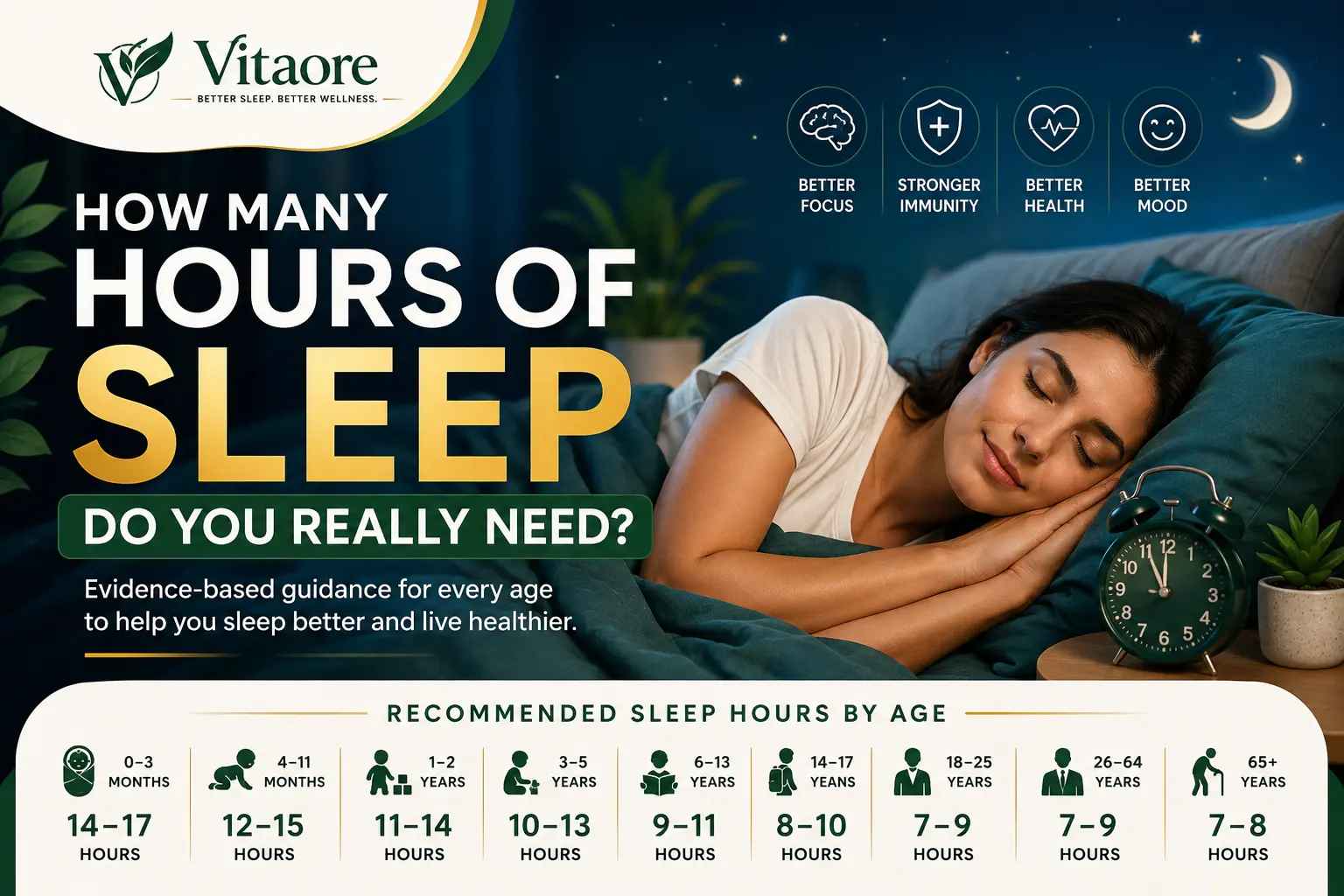
| Age | Recommended Sleep |
|---|---|
| Newborns, 0 to 3 months | 14 to 17 hours |
| Infants, 4 to 11 months | 12 to 15 hours |
| Toddlers, 1 to 2 years | 11 to 14 hours |
| Preschoolers, 3 to 5 years | 10 to 13 hours |
| School-age children, 6 to 13 years | 9 to 11 hours |
| Teenagers, 14 to 17 years | 8 to 10 hours |
| Young adults, 18 to 25 years | 7 to 9 hours |
| Adults, 26 to 64 years | 7 to 9 hours |
| Older adults, 65 years and older | 7 to 8 hours |
For infants, toddlers, preschoolers, and young children, recommended sleep generally includes sleep obtained through naps as well as nighttime sleep.
These numbers are guidelines rather than rigid requirements. Individuals can differ in their exact sleep needs.
How Much Sleep Do Adults Really Need?
For most adults, 7 to 9 hours of sleep per night is a useful target.
The American Academy of Sleep Medicine recommends that adults regularly get at least 7 hours of sleep to promote health, daytime alertness, and productivity. The organization also recognizes that individual sleep needs vary based on genetic, behavioral, medical, and environmental factors.
This is why there is no single number that works for every adult.
One person may naturally feel refreshed after about 7 hours, while another may need closer to 8 or 9 hours to feel alert and function well during the day.
Your sleep needs can also change over time. Sleep patterns commonly change with age. Older adults, for example, may experience changes in their circadian rhythm, wake earlier, or spend less time in certain stages of sleep.
Instead of asking only, “How many hours did I sleep?” it can be more useful to ask:
Do I wake up feeling reasonably refreshed, stay alert during the day, and function normally without constantly fighting sleep?
Those questions provide additional context about whether your current sleep pattern is working for you.
Is 7 Hours of Sleep Enough?
For some adults, yes.
Seven hours falls within the recommended range for adults, and the AASM recommends at least 7 hours of sleep regularly for healthy adults.
However, that does not mean every person who sleeps exactly 7 hours is automatically getting enough sleep.
Pay attention to how you feel and function during the day. If you regularly feel extremely sleepy, struggle to concentrate, rely heavily on caffeine to stay awake, or wake feeling unrefreshed, you may need to look more closely at your sleep habits and sleep quality.
Sleep deficiency can interfere with concentration, decision-making, reaction time, learning, work, school, driving, and social functioning.
There is also an important distinction between occasionally sleeping 7 hours and consistently getting less sleep than your body needs.
Is 8 Hours of Sleep Really Necessary?
No. Eight hours is not a universal biological requirement.
The idea that everyone must sleep exactly eight hours is an oversimplification. Eight hours sits comfortably within the recommended range for most adults, which is why it is often used as a convenient target.
But your individual sleep needs may be somewhat different.
For example, one healthy adult may feel completely refreshed after 7 hours, while another may need closer to 9 hours. Both can fall within generally accepted recommendations.
Sleep recommendations are general guidelines rather than strict rules, and some people need less than 7 hours while others may need more.
Rather than trying to force yourself to reach an exact number every night, aim for enough consistent, good-quality sleep to support your daytime functioning.
Can You Get Too Much Sleep?
More sleep is not automatically better.
Regularly sleeping for unusually long periods can be associated with health problems in observational research, but that does not necessarily mean that sleeping longer directly causes those health problems.
There are also situations in which sleeping more than 9 hours may be reasonable. Longer sleep can be appropriate for some young adults, people recovering from accumulated sleep loss, and people who are ill.
An occasional long night should therefore not automatically concern you.
You might naturally sleep longer after several nights of insufficient sleep, during recovery from illness, or after significant changes to your routine.
However, if you regularly sleep for long periods and still feel exhausted or unrefreshed, it is worth discussing the situation with a healthcare professional. Persistent sleepiness can sometimes be related to an underlying sleep disorder or another health issue.
Sleep Duration vs. Sleep Quality: Which Matters More?
Both matter.
Getting enough hours of sleep is important, but simply spending a certain number of hours in bed does not guarantee restorative sleep.
Sleep quality describes how well you sleep. It can include factors such as whether you stay asleep throughout the night, how frequently you wake up, how long it takes to fall asleep, and how refreshed you feel in the morning.
If you wake feeling refreshed and have enough energy to get through your day, the exact number of hours may be less important than you might think.
For example, consider two people who each spend eight hours in bed.
One sleeps fairly continuously and wakes feeling refreshed.
The other wakes repeatedly throughout the night and feels exhausted the next morning.
Although both spent eight hours in bed, their actual sleep experience was very different.
Good sleep involves more than duration. Sleep health also includes appropriate timing, regularity, quality, and the absence of significant sleep disturbances.
That does not mean sleep quality makes insufficient sleep acceptable. Regularly sleeping too little can still affect health and daytime functioning even if the sleep you do get feels relatively uninterrupted.
If you’re getting enough sleep but are still interested in improving your nighttime sleep experience, you can also read our Yu Sleep Review for a closer look at its ingredients, potential benefits, safety considerations, and available evidence.
How Do You Know If You’re Getting Enough Sleep?
There is no simple home test that can tell you exactly how many hours you personally need.
However, your daytime experience can provide useful clues.
Signs you may be getting enough sleep
You may be getting an appropriate amount of sleep if you generally:
- Wake feeling reasonably refreshed
- Stay alert throughout most of the day
- Can concentrate without constantly fighting sleep
- Have enough energy for normal activities
- Maintain a relatively consistent sleep schedule
- Do not need excessive amounts of caffeine to remain awake
Signs you may not be getting enough or good quality sleep
You may want to look more closely at your sleep if you regularly experience:
- Daytime sleepiness
- Difficulty concentrating
- Slower reactions
- Irritability or mood changes
- Waking feeling unrefreshed
- Frequently sleeping much longer on days off
- Difficulty staying awake during quiet activities
- Needing caffeine throughout the day just to function
These signs do not prove that you have a sleep disorder. They simply indicate that your sleep habits or sleep quality may deserve closer attention.
What Happens If You Don’t Get Enough Sleep?
Missing sleep occasionally is different from consistently getting less sleep than your body needs.
A poor night’s sleep may leave you tired or less focused the following day. But ongoing sleep deficiency can have broader effects.
Insufficient sleep can interfere with learning, concentration, decision-making, memory, emotional regulation, reaction time, and daily performance. It can also increase the likelihood of mistakes and accidents.
Sleep is also important for physical health. Ongoing sleep deficiency is associated with a range of health problems, including high blood pressure, heart disease, obesity, and stroke.
It is important not to interpret these findings as meaning that one short night will cause a serious health condition. Health outcomes are influenced by many factors, and research often examines patterns of sleep over time.
The bigger concern is persistent inadequate sleep.
Can You Catch Up on Lost Sleep?
Sleeping longer after an occasional short night can help you feel better, but it is not a perfect substitute for consistently getting enough sleep.
For example, if you stay up late one night and sleep longer the next night, you may feel more rested. Your body can recover from some temporary sleep loss.
The situation is different when insufficient sleep becomes a regular pattern.
Sleeping more on days off may be a sign that you are not getting enough sleep during the week. Although additional sleep may help you feel better temporarily, large differences between weekday and weekend schedules can also disrupt your sleep-wake rhythm.
A better long-term strategy is to create a schedule that gives you enough opportunity for sleep regularly.
Think of catching up on sleep as recovery, not as a replacement for healthy sleep habits.
How to Get the Right Amount of Sleep
If you are consistently falling short of your recommended sleep, small changes to your routine can help.
Keep a consistent schedule.
Try going to bed and waking up at roughly the same times each day, including weekends. A consistent wake time can help support a predictable sleep pattern.
Give yourself enough time in bed.d
If you need to wake at 6:30 a.m., do not routinely stay up so late that getting 7 or more hours becomes impossible.
Create a relaxing bedtime routine. ne
Give yourself time to wind down before bed. Reading, journaling, meditation, or another quiet activity can help create a consistent transition into sleep.
Pay attention to caffeine and alcohol.
Caffeine and alcohol can interfere with healthy sleep patterns. Consider limiting them close to bedtime, particularly if you notice that they affect your sleep.
Make your bedroom comfortable.
A dark, quiet, comfortable bedroom can make it easier to maintain good sleep quality. Reducing unwanted noise and light may be particularly helpful if your environment regularly interrupts your sleep.
Stay physically active
Regular physical activity is associated with healthier sleep and can be part of a healthy overall sleep routine.
Get natural light during the day
Exposure to natural light, particularly earlier in the day, can support your body’s sleep-wake rhythm. Getting outside during the day can also encourage regular physical activity.
When Should You Talk to a Doctor About Your Sleep?
Sometimes the problem is not simply that you are not spending enough time in bed.
Consider talking with a healthcare professional if you regularly:
- Have trouble falling asleep or staying asleep
- Wake up feeling exhausted despite allowing enough time for sleep
- Experience significant daytime sleepiness
- Snore loudly regularly
- Wake up gasping or choking
- Have sleep problems that interfere with work, school, driving, or daily activities
- Sleep for long periods but still do not feel rested
Persistent sleep problems can have many possible causes. For example, insomnia can involve difficulty falling asleep, staying asleep, or getting restorative sleep despite having enough opportunity to sleep.
If you consistently do not feel rested despite making appropriate efforts to improve your sleep, professional evaluation may be worthwhile.
Frequently Asked Questions
How many hours of sleep do adults need?
Most adults should regularly get at least 7 hours of sleep. A commonly recommended range for adults ages 18 to 64 is 7 to 9 hours, while adults 65 and older are generally advised to get 7 to 8 hours. Individual needs can vary, so these numbers should be treated as general recommendations rather than strict rules.
Is 7 hours of sleep enough?
Seven hours can be enough for some adults and falls within the generally recommended range. However, not everyone has identical sleep needs. If you regularly feel sleepy, unfocused, or unrefreshed during the day, you may need to examine your sleep duration, sleep quality, schedule, or other factors affecting your rest.
Is 8 hours of sleep necessary?
No. Eight hours is not a universal requirement. It is simply a convenient target that falls within the recommended range for most adults. Some people may feel well rested with around 7 hours, while others may function better with closer to 9 hours. Individual sleep needs can vary.
How many hours of sleep do teenagers need?
Teenagers ages 14 to 17 are generally recommended to get 8 to 10 hours of sleep each night. Teens often have schedules that make getting enough sleep difficult, so maintaining a consistent sleep routine and allowing adequate time for sleep can be especially important.
How much sleep do older adults need?
Adults ages 65 and older are generally recommended to get 7 to 8 hours of sleep. Sleep patterns can change with age, including changes in sleep timing and nighttime awakenings. Older adults who regularly feel exhausted or unrefreshed despite getting adequate time for sleep should discuss the issue with a healthcare professional.
Can you get too much sleep?
Occasionally sleeping longer than usual is not necessarily a problem. You may need additional sleep after illness or periods of insufficient sleep. Regularly sleeping for unusually long periods while still feeling tired, however, may deserve professional evaluation. Research has found associations between long sleep duration and some health outcomes, but these associations do not prove that longer sleep itself causes those conditions.
How do I know if I’m getting enough sleep?
Look beyond the number on your sleep tracker. If you generally wake reasonably refreshed, remain alert during the day, and can concentrate and function normally, your current sleep amount may be working well for you. Persistent daytime sleepiness, difficulty concentrating, or waking unrefreshed may indicate that your sleep duration or quality needs attention.
Can you catch up on lost sleep?
Extra sleep after an occasional short night can help you feel more rested, but regularly relying on weekend sleep to compensate for inadequate weekday sleep is not an ideal long-term strategy. A more consistent sleep schedule that provides enough time for sleep each night is generally a better approach.
The Bottom Line
So, how many hours of sleep do you really need?
For most adults, 7 to 9 hours is a practical range, with at least 7 hours regularly recommended by major sleep health organizations. But there is no single number that is perfect for every person.
Your age, individual biology, lifestyle, health, sleep schedule, and sleep quality all matter.
Instead of obsessing over whether you got exactly 8 hours, look at the bigger picture. Are you sleeping consistently? Do you wake reasonably refreshed? Can you stay alert and focused during the day? Are you regularly struggling with sleepiness or fatigue?
Those questions can tell you more about your sleep health than a single number on a clock.
If you consistently get what should be an adequate amount of sleep but still feel exhausted or have significant difficulty sleeping, do not simply assume that you need to spend more time in bed. A healthcare professional can help determine whether an underlying sleep disorder or another health issue could be involved.
Medical Disclaimer
This article is provided for general educational and informational purposes only. It is not intended to replace individualized medical advice, diagnosis, or treatment. Sleep needs vary from person to person. If you have persistent sleep problems, excessive daytime sleepiness, breathing problems during sleep, or other concerns about your health, speak with a qualified healthcare professional.