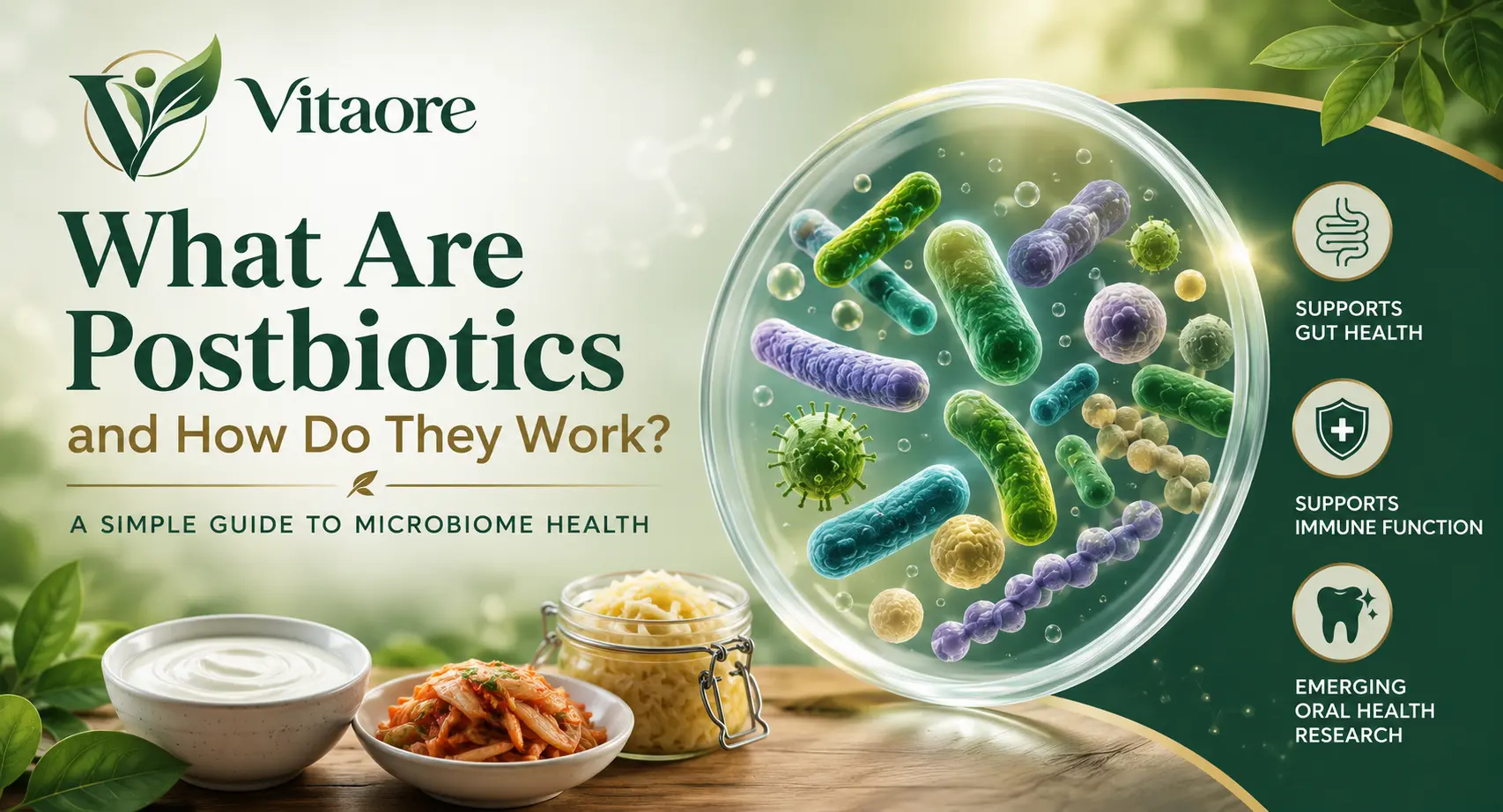
What Are Postbiotics and How Do They Work? A Simple Guide
If you have heard of probiotics and prebiotics, you may now be wondering what postbiotics are and why they are attracting attention. In simple terms, postbiotics are preparations made from inactivated microorganisms and/or their components that can provide a health benefit. Unlike probiotics, they do not depend on living microorganisms being present in the final preparation. Researchers are studying postbiotics for digestive health, immune responses, microbiome interactions and other potential applications. However, postbiotics are not one single ingredient, and evidence can vary considerably between preparations, doses, populations and health outcomes.
What Are Postbiotics?
The modern scientific definition of a postbiotic is more specific than the older description of postbiotics as simply the “waste products” produced by probiotics.
The International Scientific Association for Probiotics and Prebiotics, or ISAPP, defines a postbiotic as a preparation of inanimate microorganisms and/or their components that confers a health benefit on the host. This means a qualifying postbiotic needs to contain inactivated microbial cells or their components, and its health benefit needs to be demonstrated in the intended host.
Depending on the preparation, postbiotics can involve:
- Inactivated microbial cells
- Cell wall components
- Bacterial lysates
- Other microbial components
- Certain microbial substances present alongside the inactivated cells
One important point is that non-living does not necessarily mean biologically inactive. Components from microorganisms can still interact with cells and biological pathways after the microorganisms themselves have been inactivated.
The current scientific definition also means that a purified microbial metabolite is not automatically a postbiotic simply because bacteria produced it.
How Do Postbiotics Work?
Researchers are still working out exactly how different postbiotic preparations produce their effects. There is no single mechanism that applies to every postbiotic.
Potential mechanisms being investigated include interactions between microbial components and:
- Immune cells
- Intestinal or other epithelial cells
- Microbial communities
- Inflammatory signaling pathways
- Protective tissue barriers
For example, short-chain fatty acids such as butyrate have been extensively studied in relation to gut biology. However, it is important not to assume that every product containing a microbial compound will produce the same effects.
Cleveland Clinic notes that scientists still do not fully understand how all postbiotics work. Some of the interest comes from the possibility of using specific microbial components without needing the microorganisms themselves to remain alive.
Postbiotics vs. Probiotics vs. Prebiotics
These three terms are related, but they describe different things.
| Type | What it means | Main idea |
|---|---|---|
| Probiotics | Live microorganisms that provide a health benefit when administered appropriately | Introduce specific live microorganisms |
| Prebiotics | Substrates selectively used by microorganisms that provide a health benefit. | Provide material microorganisms can use |
| Postbiotics | Preparations of inanimate microorganisms and/or their components that provide a health benefit | Use non-living microbial preparations. |
The distinction matters because evidence for one category does not automatically apply to another. A probiotic study, for example, does not establish that a postbiotic preparation will have the same effect.
Postbiotics also should not automatically be considered better than probiotics or prebiotics. Each approach has different characteristics, and the relevant evidence depends on the specific preparation and intended use.
What Are the Potential Benefits of Postbiotics?
Research into postbiotics covers several areas, but the strength of evidence differs substantially.
Digestive Health
Some postbiotic preparations have been investigated for digestive symptoms and gastrointestinal conditions. Research has included areas such as diarrhea and irritable bowel symptoms.
However, “postbiotics” describes a broad category rather than a single treatment. Results from one preparation should not automatically be generalized to every postbiotic supplement.
Immune Function
Researchers are also studying whether certain postbiotic preparations influence immune responses.
Some studies have reported potentially useful effects, but this does not mean postbiotics universally “boost immunity.” The specific preparation, dose, and population matter.
Inflammation
Certain microbial components and metabolites can interact with biological pathways involved in inflammation. This has generated interest in postbiotics as a potential research area.
That does not establish that postbiotics treat inflammatory diseases.
Gut Barrier and Microbiome Interactions
Another area of research involves how microbial components interact with intestinal cells and the surrounding microbial environment.
These findings can help explain possible biological mechanisms, but laboratory or mechanistic evidence is not the same as proof of a clinical benefit in humans.
What Does the Research Say About Postbiotics?
The evidence should be considered in layers.
Laboratory research can help scientists understand how a microbial component behaves in cells or biological models. It cannot by itself establish that a supplement works in people.
Animal research can provide useful information about possible mechanisms and safety, but results cannot automatically be applied to humans.
Human clinical trials provide more direct evidence. Even then, researchers need to consider the study population, preparation, dose, duration, and outcome being measured.
Systematic reviews can provide a broader picture, but their conclusions depend on the quality and consistency of the studies available.
This is particularly important with postbiotics because products can differ considerably. Evidence for one preparation does not automatically prove that another postbiotic product will have the same effect.
Are Postbiotics Good for Gut Health?
Some postbiotic preparations have been studied for gastrointestinal health, but postbiotics should not be viewed as a single ingredient or treatment.
Short-chain fatty acids are an important example of microbial metabolites studied in gut health. Other research involves microbial components and their interactions with intestinal cells.
One important terminology point is that not every short-chain fatty acid supplement is automatically a postbiotic. Under the ISAPP definition, a postbiotic requires a preparation of inanimate microorganisms and/or their components with a demonstrated health benefit.
The evidence therefore needs to be evaluated according to the actual preparation being studied.
Can Postbiotics Support Oral Health?
Postbiotics are not limited scientifically to the digestive tract. The ISAPP consensus specifically notes that a postbiotic may act at host surfaces including the oral cavity, as well as the gut, skin and other sites.
This has created interest in potential oral-health applications involving:
- The oral microbiome
- Microbial interactions
- Dental biofilms
- Oral tissues
- Inflammatory processes
- Microbial components
Recent research has investigated postbiotics in relation to dental caries and oral microbial activity. However, the evidence remains an emerging area, with studies varying in preparation, design and outcome. A recent systematic review found that much of the available research was laboratory-based, while only a small number of randomized clinical trials were available.
Therefore, research into postbiotics in general does not prove that every postbiotic supplement improves oral health.
Postbiotics should not be presented as a replacement for:
- Brushing with fluoride toothpaste
- Cleaning between the teeth
- Professional dental care
- Treatment for diagnosed dental conditions
Can Postbiotics Replace Probiotics?
Not necessarily.
Postbiotics and probiotics use different approaches. Probiotics contain live microorganisms, while postbiotic preparations contain inactivated microorganisms and/or their components.
Researchers are interested in postbiotics partly because some preparations may be easier to stabilize and formulate than products that need to maintain living microorganisms. This could offer practical advantages for certain applications.
That does not mean postbiotics are always safer, more effective, or more stable than every probiotic.
The appropriate option depends on the specific product and the evidence supporting it.
Are Postbiotics Safe?
Safety depends on the specific preparation, ingredients, dose, and intended population.
A product marketed as a postbiotic should not automatically be considered risk-free simply because it contains non-living microorganisms.
People should be particularly cautious about supplements if they:
- Have an underlying medical condition
- Take prescription medications
- Are pregnant or breastfeeding
- Are considering supplements for a specific health problem
- Have a weakened immune system
Product-specific safety information is more useful than assuming that all postbiotics have identical safety profiles.
If you are considering a postbiotic supplement for a medical or dental concern, discussing it with an appropriate healthcare professional is a sensible step.
How Do You Get Postbiotics?
This question is more complicated than simply identifying a list of “postbiotic foods.”
Fermented Foods
Foods such as yogurt with live cultures, kefir, kimchi, sauerkraut, miso, and tempeh contain microorganisms and compounds produced during fermentation. Harvard Health and Cleveland Clinic discuss fermented foods in the context of postbiotic production and microbiome health.
However, not every fermented food should automatically be labeled a postbiotic.
High-Fiber Foods
Foods rich in fiber can support microbial fermentation in the gut. This process can contribute to the production of microbial metabolites.
That does not mean eating fiber is the same as consuming a defined postbiotic preparation.
Supplements
Commercial postbiotic supplements may contain particular inactivated microorganisms or microbial components. Because formulations vary, it is important to evaluate the actual ingredients and evidence rather than relying only on the word “postbiotic” on the label.
What Are Postbiotic Supplements?
Postbiotic supplements are products designed to provide specific microbial preparations or components in a concentrated form.
When evaluating one, consider:
- The microorganism or microbial source
- How the preparation was produced
- The specific components included
- Amount per serving
- Manufacturer information
- Safety information
- Evidence involving the actual preparation
- Whether human clinical research supports the claimed benefit
A product label calling something a “postbiotic” does not by itself prove that the finished product provides the health benefit being advertised.
The ISAPP consensus is particularly useful here because it emphasizes both the nature of the preparation and demonstrated benefit in the intended host.
What Should You Look for in a Postbiotic Supplement?
If you are considering one, look for transparency rather than broad marketing claims.
A reasonable checklist includes:
- Clearly identified microbial source
- Clearly described preparation
- Specific serving information
- Transparent manufacturer information
- Appropriate safety information
- Evidence relevant to the actual formulation
- Clear directions for use
- Claims that match the available research
Most importantly, do not confuse research on an individual microorganism or microbial compound with research on the finished supplement.
What About Postbiotics in DentaBiome?
DentaBiome is marketed as an oral-health supplement that uses a postbiotic approach. Whether a finished product provides meaningful benefits is a separate question from whether postbiotics as a category are scientifically interesting.
If you’re researching an oral-health supplement that uses a postbiotic approach, our DentaBiome Review guide examines its ingredients, proposed benefits, safety considerations, pricing, customer experiences, and available evidence.
Are Postbiotics a Cure for Health Problems?
No.
Postbiotics are an emerging area of research, not a universal treatment for disease.
They should not be presented as a way to:
- Cure disease
- Prevent all infections
- Eliminate harmful bacteria
- Permanently rebalance the microbiome
- Replace prescription medication
- Replace dental care
- Replace a balanced diet
Research needs to be evaluated according to the specific postbiotic, condition, dose, and population being studied.
The Future of Postbiotic Research
Postbiotic research is attracting interest because scientists are exploring whether specific microbial preparations can provide useful biological effects without relying on living microorganisms.
Future research needs to clarify:
- Which preparations are effective
- Which health outcomes they influence
- Appropriate doses
- Which populations benefit
- Long-term safety
- How different preparations work
- Whether oral applications provide meaningful clinical benefits
This is particularly important for oral health, where researchers are investigating how microbial preparations may interact with dental biofilms and the oral environment. Recent reviews describe potential applications while also emphasizing the need for stronger clinical evidence.
The Bottom Line
So, what are postbiotics? They are preparations of inanimate microorganisms and/or their components that provide a demonstrated health benefit to the intended host. They differ from probiotics and prebiotics, and researchers are investigating their potential effects on areas including gut, immune and oral health. The evidence is promising in some areas but varies considerably between preparations. Oral-health applications are still developing, so postbiotics should complement rather than replace established dental and health practices.
Medical Disclaimer
This article is for general educational purposes only and does not replace individualized medical advice, diagnosis, or treatment. If you have a medical condition, take prescription medications, are pregnant or breastfeeding, or are considering a dietary supplement for a specific health concern, speak with a qualified healthcare professional.

Related Posts
Foods for Healthy Teeth and Gums: What to Eat